Thursday, October 30, 2008

The Gardener is IN

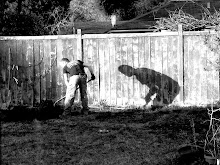
Knee-deep in Kale, Cabbage, Parsley and Pansies, my co-worker and I were approached today by a bundled-up utility worker on his lunch break. Over our damp afternoon chatter, he struck up a blazing conversation which, in the span of 2 minutes, chain-reacted from "So is this your house?" to "How long it take you to cut these bushes like this?" to "So you guys are voting, right?"; into the real fissile stuff: a meltdown of hopeful commiserations and genuinely thought-provoking comments on work, war, taxes, abortion, problems with the neoconservative agenda, and the disappearance of the middle class. Through his whole lunch break he remained, casually pacing on the other side of a low boxwood hedge, punctuating occasional silences with unassuming ruminations on decidedly assuming topics.
I'd consider the whole progression pleasantly odd were it not for the fact that these types of conversations and their instigators find me regularly, but only while I am visibly plying my trade. When I was working in the nursery, customers would volunteer to me startlingly personal and emotional tidbits, almost mid sentence as I offered inane plant-related banter: "Yes, the blue of this pine makes it a striking accent to use in..."
"...It's just weird, y'know? You start getting older and you look around one day and all of a sudden half your friends have cancer..."
"..."
"Just weird..."
"...um..."
I don't know what it is about gardeners and plant people that broadcasts an open ear/shoulder- to- cry- on- vibe. Through encounters like this I end up getting frayed glimpses of the loneliness, disappointment and anger which, when channeled into the more brackish sloughs of societal expression, lead to things like road-rage, substance/domestic abuse, and depression. We're practically bludgeoned with advice to "let it out" and "talk about it" but the truth is most people have no one with whom they feel safe enough and from whom they feel removed enough to talk to at all. To these people I offer the following advice: go to a nursery, walk around the block, go someplace where there are folks with cheerful, dirty hands talking about plants and join in. It doesn't matter whether or not you know anything about plants; you'll instinctively steer the conversation where it needs to go to get something off your chest, which, though the gardeners may be caught off guard, is fundamentally better than steering your car into the a**hole who just cut you off.

Sunday, October 19, 2008

Just A Pansy

Sometime last fall while working at a nursery with my brother, I waxed ebullient over a new shipment of pansies/violas and made the mistake of confessing: "I can't help it, I just love pansies!" within earshot of said brother. Now, I'm generally not one to fret over my projected masculinity, but in a nursery where my brother and I were the only young men employed and were (ostensibly) hired as grunt labor and extra muscle, I occasionally felt compelled to represent my demographic with a bit of swagger. Sadly, this slip of my tongue paired with the looseness of my brother's was to make any future display of testosterone moot as it would invariably be followed with a snickering "yeah, but he just looooves pansies". Before long, every employee, customer and neighbor within 10 miles knew that my favorite flower (and thus gardening philosophy, attitude and lifestyle) was eponymous with a timid weakling. To make matters worse, my brother ever after claimed that HELLEBORES were his favorite plant. Spoken with a gruff, manly voice, HELLEBORE sounds more like a futuristic siege weapon than a plant, and comes off as orders of magnitude more masculine than pansy.
I learned to live with it, and despite the fact that they are common and wimpy-sounding, I've learned to accept my love of pansies and violas. I will try to post a picture of my favorite for this year: Viola x williamsii 'Velour Blue Bronze'.

Viva La Vitis

Vineyards aplenty
What else stomped and forgotten
Gets better with time?

Tuesday, October 14, 2008

Nightmare Weed

All right, I'm curious. I am engaged in an ongoing debate/dialogue/cursing fest with myself and coworkers regarding which of many is the worst weed/invasive species to remove. I tend to go back and forth between Oxalis (oh those pretty little shamrocks from hell) and bindweed (Convolvulus arvensis, whose explosive germination any time earth is moved from one spot to another seems to support the centuries-old theory of spontaneous generation).
Less common, but more likely to spawn genuine nightmares is Alstroemeria. I kid not, after a whole afternoon of digging and searching for these elusive, grave-depth fleshy tubers I had a restless sleep in whose dreams I was likewise digging endlessly, but with my spade repeatedly striking and uncovering unexpected objects like full bottles of insecticide spray. This was disturbing in a way that I can't quite justify or explain. Last week I returned to a garden from which I meticulously removed every last trace of Alstroemeria to install some plants. Lo and behold, when digging holes at a depth of 12-18", I began to unearth those wormy white clumps that would be next years crop. For all I know, these tubers penetrate the Earth's mantle and can be found well into the core of the planet; I am afraid to ask whether oil-drilling outfits have contingency plans for encountering abnormally large Alstroemeria clumps at depths over 2 miles. I can no longer simply smile and compliment someone's lovely bouquet of store-bought Alstroemeria without choking back a grimace and repressing a handfull of insidious memories.
Thus, after some delay, to my aforementioned curiousity. I would like to know what other people's nightmare weeds are, and for what reason. Please feel free to leave your opinions in the comments section. If I get enough different responses, I would like to put up a poll so others can vote on their least-favorite weeds.

Friday, October 3, 2008

Wisteria and Grizzly Bears

A lovely old home, one of my favorite gardens in which to work... not so when the lovely old home is due to be repainted and said garden has, come to think of it, been planted woefully close to the house.
I can handle pruning shrubs off of houses; it is cramped, intimate work but one can almost feel the home breathe its first deep breath in years when it is no longer smothered by, e.g. , several ten foot Myrica planted 1.5 feet away from its wall. I can handle covering rose bushes in tarps. I can handle shearing cozy Thuja off of house corners. What I can not handle is the ancient, beautiful Wisteria which has, true to form, enveloped the southern face of the house in a nice, gnarled bear hug.
I'm going to place the age of this specimen at about 3 years older than the house itself, possibly the result of a wayward seed dropped from the pocket of a horticulturally inclined surveyor laying the first tentative lines of the neighborhood. 3 years later when home construction began, I'm guessing the Wisteria was already of such massive, coiled stature as to dictate property lines and foundation placement. No architect, contractor, gardener or engineer could be found who was willing to pit the tools of his trade against that Gordian knot of vegetation. So they just built around it.
Decades later, some well-meaning but utterly foolish home owner naively erected a lattice, attached to the house (!), for this beast. I'll go ahead and liken this fated move to, say, laying table scraps around the perimeter of your home because you've noticed that the local grizzly bear population has rather pretty fur and so why not get a closer look?
Grizzlies and Wisteria both have a powerful sort of beauty. I'll hazard a guess and say that Wisteria even smells better than any bear, grizzly or otherwise. Both should be appreciated, but either from a distance or from behind a very sturdy cage.
In bloom and in scent, Wisteria is unparalleled. Make no mistake though, it will devour any structure (and possibly any family member) you place it near. If you are (or can hire a) very disciplined gardener who can faithfully prune the vine off of walls/fences etc. about twice a week during the growing season, then by all means do as you wish. I guess this would be like going out and tazering the grizzlies anytime they start sniffing around the front door. Do not let the plant have its way, claiming walls, drainpipes, and windows and then hire a mortal gardener to free those those walls, drainpipes and windows so that they may be repainted; I'll not strain the grizzly analogy any further, just don't do it.

Tuesday, September 30, 2008

Out With The Ferns, In With The...Oxalis?

My working definition of a weed is any volunteer plant that I am routinely asked to remove from a given garden. Since I have no garden of my own, the only weeds I can define for myself are the ones tenacious enough or of seed omniscient enough to sprout up in my numerous container plantings. I am not fond of these weeds, as I'd like to think one of the few benefits of not having a garden would be an absence of menial maintenance tasks such as weeding. Therefore, I have no great attachment to the grasses, dandelions and liverworts I disgustedly pluck from my pots when they begin to obscure my beloved plants.
It is considerably more difficult to align my weed definition with my gardening conscience when I am in a certain client's garden. Especially when said client is instructing me to "dig out those pesky ferns" because they are "everywhere". The ferns in question are two or three lovely western sword ferns (Polystichum munitum) of modest size and excellent health which, despite my being able to count them on one hand, are apparently everywhere. Now let's never mind that these are native to this area and so were springing up as "weeds" eons before humans slapped up their poorly-proportioned million-dollar ramblers-with-a-view on the site. Let's instead consider that this client puts her foot down on a few sword ferns, branding them weeds, while all about her sprout the immortal heads of at least a dozen terribly invasive species which truly are everywhere and which she herself introduced into her garden. Oxalis, Alstroemeria, Aegopodium, Ajuga, Digitalis, Aquilegia (not the native), and Angelica abound, to name a few.
I propose that we show some tolerance for sword ferns (which, by the way, are quite easy to remove and relocate if necessary) and show some discretion in the aggressive plants we willingly bring into our gardens. Future home-owners and gardeners alike will thank us.

Thursday, September 25, 2008

Sod Knife...Really?

Thank you, but I'll pass on the sharpened, curved cheese knife handed to me as a sod-cutting implement today. True, this was my first real experience laying and cutting sod, but for the love of god a sod-knife should, unless I am comically mistaken, be able to cut... sod!
Tomorrow the toothbrush-handled cheese knife stays in my tool bucket and I shall once again employ my Leatherman tool to finish a job at which the nominally ideal tool has failed. (However, the next time I happen upon an unclaimed wheel of smoked Gouda tossed into the garden in a fit of Roman excess by an affluent client, I daresay it will be elegantly sliced and delivered to my tongue in no time at all.)

Friday, September 19, 2008

Intentions

Not to make this sound too much like a teenage courtship from the good ol' days, but I would like to announce my intentions towards this blog. If you determine that my intentions are pure and that my rational facilities are not too much smothered by adolescent hormones, I beg your blessing to carry on. I will treat your precious gardening opinions with respect and try not to let my grubby hands wander where they are unwelcome.
During countless hours of "Zen Time" (our affectionate euphemism for the brain-dead state achieved by the repetitive-task gardener) the plants and gardens with which I work insinuate themselves into my subconscious until they eventually cross-breed with my preconceptions and give beautiful birth to opinions and (hopefully, if I'm a good parent) wisdom.
Here is where I will lay out these marinated thoughts on gardening, plants and life to be either digested and learned from or spit out, rejected. Let me know where you agree, where you disagree, and where you are so opposed that it causes you physical pain to read any further. Thank you and enjoy. Or do not, but still partake.

Wednesday, September 17, 2008

In The Beginning

In the beginning, there was a student. Smart, but not that smart; the type to crack a (hopefully) knowing smile at witty dialogue or nerd jokes, but never to join in, to chuckle derisively at improperly phrased Physics adages uttered by his friends, but never to explain (or even understand, necessarily) their impropriety.
He discovered, studied, found the meaning of life in, grew bored with and summarily discarded the following subjects: Anthropology, Physics, Astrophysics, Linguistics, Organic Chemistry, Volleyball, Quantum Physics, Molecular Biology, Anthrophysics, Astrolinguistics, Ethanology (not so readily dismissed), Frisbee, Philosophy, Molecular Volleyball and, finally, Botany.
Botany proved easily translatable into a college degree without requiring a whole lot of touchy-feely, confidence-building human interaction. Plus, it was genuinely interesting and allowed hedonistic, booze-fueled weekend nights in the botany lab poking at weeds under a pair of microscopes. Unfortunately, a Botany degree itself does not translate well into the language of post-collegiate job markets, as there are very few Fortune 500's willing to hire or even to sub-contract someone to hole up in a an expensive lab and count carpels 'til the cows come home.
Not willing to abandon a plant-based career, the (now) graduate sat down and thought very long and hard about how plants could be associated with money. "Well now, is there perhaps a place where people exchange money for plants?" He asked himself. The answer was yes, and the next thing he knew, he was up to his knees in the bark mulch of the glorious retail nursery industry. He wiled away nigh on two years thusly, then dusted off his dichotomous keys and expectations and moved to the city to seek his fortune (this being staggeringly difficult to come by in said nursery industry).
Like an injured person dumbly prodding their injury to establish that, yes, they are still injured and for crying out loud yes, it still hurts, the graduate secured a white-collar cubicle job to see it it really was as miserable as it gave every indication of being. It was. After four months of alternately staring at a computer screen, making scientific labels and envying the lucky immigrant workers blowing leaves on the sidewalks outside, he slapped himself awake with an immunohistochemistry diagnostic manual and got the hell out of there. He made off with naught but a snazzy collection of office-casual sweaters and mild claustrophobia.
An unspecified and inglorious period of unemployment was to follow, as he sought compensation for getting his hands dirty and correcting stranger's bad botanical Latin. Then, like a drunken fisherman piling fish in the boat after baiting his hook with bits of powdered donut and beef jerkey for a good laugh, he discovered that this was, in fact, the job description of a gardener. He became... a gardener. He wears a hori-hori knife and two pairs of pruners on his belt. You never know, he could be... your gardener.