Friday, March 27, 2009

Squirm

Under the soil
Just an inch or two
All the worms
Unseen
Until you go digging
And you always go digging
Turning spades and thoughts in turn
To see what's under squirm

Friday, March 20, 2009

Curse Of The Hederahelix

I do not care about your hardwood floors. Nor do I care about your designer furniture, each piece of which undoubtedly cost more than my car. I do not care about anything behind those massive windows and that meticulously maintained siding. If you hire me to increase the curb appeal (if I may bandy about a buzzword) of your soon-to-hit-the-market home, I just don't care about anything other than how your yard looks and how it compliments the exterior of your home. Rest assured this is not apathy on my part; I am a gardener and it is my job to know how plants and landscapes affect people on both a conscious and subconscious level. Nowhere on my resume does it mention 20th century movements in interior design, and your expertise clearly ends at the walls of your house or else you would not have sought my help.
Therefore: get rid of the ivy.
Trust me.
If you take from me one piece of advice and ignore all else, let this be it.
I'm sure the thought of English Ivy sends all sorts of classical, white-marble allegories prancing through your head, but to many people this green, snaking, choking beast represents something else entirely. It is the raw, coiled potential to destroy a yard. Slayer of trees, devourer of beds, no matter how well and often you trim it back, some potential home buyers will see that ivy for what it is: doom (I don't know if there's a buzzword for this in relation to "curb appeal", we'll just say "curb terror" and it's probably something you want to avoid). Even its Latin name, Hedera helix, seems more mythical serpent monster than plant.

...Hmm...

You know... come to think of it, keep the ivy if you want, I have a plan that's bigger than you or your house. I believe through the widespread dissemination of English Ivy's Latin name, spoken in hushed, fearful tones we could start to create the sort of urban legend fear we need to discourage the use and tolerance of ivy. For example, picture two huddled strangers on the sidewalk:
"It can't be true!"
"It is true! My sister heard from her mailman, and he knows the whole neighborhood. He's seen the Hederahelix in at least 2 yards on our street alone!"
"Oh God What do we do!? I heard of a town in Oregon that saw signs of the Hederahelix and 3 months later... the town was gone! No one could find it and no one heard from any of its citizens again! What do we do!?"
"Try to calm down. I want you to run to the hardware store and buy the biggest pair of pruning shears you can find. Do you know how to make napalm?"
"No!"
"OK, that's OK. I know you're lethal with a pair of shears, they'll have to do. Once you have those, run home and be with your children, they need you."
"But then what do we do?!"
"Then...we pray."

That's it, this will work. Curb appeal be damned, I have an urban legend to create.

Thursday, March 19, 2009

What I Tell Myself

What do you tell yourself?
During the morning commute
And the long ride home
And the interim
To make the whiled hours seem worthwhile

From what perspective
Do you watch your hands
Watch your lips move
From whose approving eyes
Do you see your own work

Outside a mortgage bank
I deadhead pansies
and sweep the sidewalk
Inside I water the plants
and try not to be seen

Maybe when folks see
(in these difficult times)
a bank with clean walks
and cheerful flowers
They think that...
Things will be OK

Tuesday, March 10, 2009

Smokin' Hot Bags

Thank you all for being here today. After careful consideration and discussion with my family, I have decided to announce that I am now accepting bids to endorse hand-warmer products...
Now please, quiet please...
I'll wait...
Thank you.
To your cries of "SELL OUT!" I can only say this: I use hand-warmers almost every day in the Winter anyway. I can only imagine how many hundreds or thousands (millions?) of people see me, shivering in the garden, pausing every five minutes to put down my pruners, gingerly remove my inadequate gloves and stuff my hands into my pockets, seeking the tiny, warm sandbaggish things waiting there for me. An over-shod gardener with poor circulation and no apparent regard for physical appearances consistently using a product for all to see? You can't dream up that kind of marketing opportunity. Now, I know what you're all thinking (mostly because some of you seem to be shouting it at me): he's a gardener; he must be loaded; what use could he possibly have for more money?
Well, put simply, I have a lifestyle to maintain, and I'll not apologize for my excesses. If eating more than one meal a day makes me a glutton, so be it. If having a 21" TV and a VCR makes me a shameless gadget-head, so be it. If wearing a completely different pair of socks every day of the week makes me a fashion slave, so be it. If carrying my garden tools around in the back of my Civic hatchback seems like a waste of a beautiful luxury automobile, so be it. I've earned this life, and your jealousy doesn't make it wrong.
...
Excellent question, thank you.
No, I will not be endorsing any hand-warmer product currently available on the market. I will be holding out for a custom line of hand-warmers specially-tailored to my needs.
...
How will they differ from currently available hand-warmers? Well, ultimately that will be up to the R+D department of the company placing the highest bid for my endorsement, but I do have a few ideas of my own. For example, commercial hand-warmers all seem to have a common and irritating design quirk: they do not work. I would like very much to endorse a hand-warmer product that actually works. A good way to achieve this goal, that I can see, is to create some kind of hand-warmer that gets warm and then makes your hand warm upon contact. It should be able to do this even when it is cold outside, because I have been known to use hand-warmers when air temperatures drop below my core body temperature. Beyond that, it's just cosmetics. I guess glow-in-the dark would be pretty cool.
...
Oh, I'll leave the naming to marketing, I'm not picky. Maybe something like "Smokin' Hot Bags" or "Pleasantly Warm Pouches" or "Hands Here For Heat" or, I don't know "Touch Me, Sexy" (I've been told that sex sells). Yeah, any of those would be just great.

Thank you all, I hope this will not change our relationship or how I am seen in the public eye.

I would like bidding to start at $80,000 per public use of hand-warmer product. For $100,000 I will turn towards my audience and utter a trademarked and memorable catch phrase.

Wednesday, March 4, 2009

11 Pages

11 pages... intricately formatted, photographed, broken down and compiled... the pruning of modern bush roses in a rather tedious nutshell. The book itself shall remain unnamed, suffice it to say it is a much-read and highly regarded pruning guide published under the authority of the... oh, we'll call it the Shmamerican Shmorticultural Shmoshmiety. After these 11 pages is a small box with a photo depicting a disembodied pair of arms holding a hedge trimmer that has just blithely chopped through a rose bush at knee height. The gist of the accompanying text: feel free to disregard the preceding 11-page rose-pruning treatise. Instead, why not just whack the things down at about, oh, here, and be done with it. Apparently recent research has indicated that this crude (and probably satisfying) treatment may produce a healthier, better-blooming plant than all the conjured intricacy and lore of rose-husbandry through the ages.
I, for one, find this hilarious, and would like nothing better than to swing a machete through some hybrid teas to demonstrate the progress of modern horticulture. But I cannot. No, I must memorize the 11 pages that don't involve rosewhacking, like homework after years of freedom, and regurgitate them the next day in an earnest bid to convince a new client that I know roses like the back of my hand and love them like the air in my lungs.
In truth, I know roses like the inside of my lungs and love them like air in a hose.
Don't get me wrong, I'm always down for a good stop-and-smell-the-roses, I just have no desire to play patient nanny to a prima donna brat of a plant like the modern rose. Any organism that requires constant aseptic attention to avoid disfiguring disease and infestation could only be the work of centuries of human meddling... akin to certain dog breeds that cannot even be birthed without human intervention. Give me Rosa nutkana or R. rugosa any day, with cheerful hips and heavenly fragrant, simple, pretty flowers whose reproductive structures have not been sacrificed in some horticulturalist's orgy of endless petals, petals and more petals.
Now, I realize that I may have just offended or alienated quite a few rose lovers (not to mention dog lovers) out there. To you I issue a challenge: prove me wrong. Show me that modern roses pull their own weight in the garden; tell me how to look past their horrible shape and thorny demeanor; tell me why I should spend another minute picking off black spot riddled leaves; tell me why I should put up with a patented, trademarked problem child when its native cousin is growing carefree along the side of the road.
Do not let this bitterness and sarcasm fool you, I genuinely wish to be convinced otherwise. One of the things I love about gardening is how often I am proven wrong and end up eating my own words; I love rediscovering plants that I had written off long ago. Gardening passions are contagious, and sometimes just hearing someone get excited about a plant, even when it is not a favorite of mine, is enough to make me re-evaluate my prejudice. So rose lovers, get excited, defend your precious pretties; tame my tongue and sheath my machete, I am an easy convert.

Saturday, February 28, 2009

Dear Nandina

Dear Nandina domestica,

There's no easy way to say this, so I'll just come right out with it...
We're through.
The love I felt for you so long ago, at the nursery, is gone. You were the perfect plant: beautiful color; mostly evergreen but sensitive enough to drop a few leaves if it got really cold; a texture and growth habit all your own; and my God, when you first let me see your little red berries I nearly lost it right there. I bragged about you to everyone I saw; you were my heavenly bamboo baby.
But now that I've gotten to know you better and I've seen what you're like away from the nursery, I know you're not the plant for me.
You grow taller than is good for you and it makes you flop over. There, I said it. I know we've argued about this before, but you just don't seem to change. No matter how many times I pick you up and faithfully stake you to bigger and bigger stakes, you escape, or if you're being belligerent you just break the stake outright, and either way, the next time I see you, you're flopped over again. I can't be the only strong one in this relationship.
And there's another thing... even when there's not enough room and even when I ask you not to, you start spreading and suckering. Well I've got something to tell you: YOU'RE NOT THE ONLY PLANT IN THE GARDEN, SO STOP ACTING LIKE YOU ARE!
I'm sorry, sometimes you just make me so angry, and I don't want to be angry anymore.
I hope we can still be friends, and if you're open to it, it'd be cool if you'd still let me see your berries once in a while, but I'll understand if that's too hard.

I'll always remember you (mostly because you're in everybody's yard)

-Me

P.S. I've been seeing your dwarf siblings for some time now. They're beautiful and they know their place. I'm not trying to hurt you, I just want to be honest; they give me what I need.

Thursday, February 19, 2009

The Fertile Warehouse

This year is to be my grand experiment in urban agriculture. For the past several years I have, as a hobby, grown a few edibles in pots on whatever outdoor surface in whatever sliver of sunlight my rental unit afforded me at the time. Results have included some mildewy peas, grumpy tomatoes, leggy herbs bolting towards reproduction like exceptionally hormonal teenagers, and a salvaged fruiting fig that may as well just join the rest of my indoor Ficus for all its prudish disinclination towards actually fruiting. But this year is different. Having managed to stay put in the same apartment for more than one season and having had marginal success with edibles last summer, I am ready to unleash the repressed farmer within. I will push the envelope of urban gardening to see just how much of my own produce I can produce from nothing but pots on a patio.
So far, this has translated into much more planning much earlier than I am used to. Unable to work my acreage with a team of horses or a tractor (these being somewhat overkill for the 10 or so incongruous square inches of actual earth to be found between the sidewalks, fences and parking lots which constitute my back yard), I must go out and find (i.e. buy) soil and containers in which to put it. This, when you think about it, is a strange but not necessarily interesting twist on the hunter/gatherer versus sedentary farmer dichotomy: I am one in order to become the other.
Moving on...
The point is, because of my stubborn determination to grow food where none should grow, I find myself in surreal places like Home Depot and Costco seeking the cheapest price for earth and pots: two of the first things humans ever knew what to do with. It came as no surprise to me, when I first braved the rush-hour madness of wholesale consumerism at its finest (aka Costco), that they indeed had the largest, most absurdly reasonably-priced bag of potting soil I'd ever seen (not just soil mind you, but if I've interpreted the bag marketing correctly, a whole potting lifestyle: with more satisfaction than a life of charity and more trademarks, patents and overall technology than cell-phones from 8 years ago). So I swallowed my pride with a bit of my soul and lugged a bag onto my oversized shopping cart (how the average Costco patron manages this feat is beyond me; I move dirt for a living and still had to concentrate mightily on thinking un-hernia thoughts). What did surprise me was the semi-aisle across from the potting soil devoted exclusively to fruit trees and blueberry bushes.
These plants, stacked and strangled by packaging, lit by a distant aircraft-hangar fluorescence, seemed as out-of-place as it's possible for plants to be. I picked up a two-pack of blueberry bushes (two different varieties even, for better pollination!) and began questioning my plan. Is this what it means to hybridize the urban and rural tendencies of humanity? Do city-dwellers get to taste the fruits of their own labor only if most of the mystery (and labor, come to think of it) is removed, all the complicated parts filled in for them? Here is part A (soil) and part B (plant); add part B to part A, wait 5 months and enjoy! Repeat the following year! Does this offer any genuine connection to our agricultural heritage? Do we feel like farmers? If Costco started selling live cattle and, across the aisle, brand new cow-slaughtering machines from GE, would they make ranchers of us all?
In the end, I decided that there are worse hobbies to have than amateur gardener/farmer (like amateur cow-slaughterer, for one) and that if busy people can find a few minutes in which to put a plant in a pot and water it a few times and get a few blueberries out of it, they probably feel a measure of happiness and satisfaction, even if it doesn't make them a bonafied dirt-whisperer with an acres-long gaze and dreams of the fertile crescent. If you think about it, the first farmers must have themselves been amateurs whose curiosity or desperation (likely both) led them to add part B to part A. So maybe the Costcoans are channeling that ancient spirit. Even if not, the more people growing their own healthy food, the better, and if Costco blueberries are a step in that direction then so be it.
At least that's what I told myself as I waited in the quarter-mile long checkout line with a shiny new shrink-wrapped two-pack of blueberry plants in my cart.

Thursday, February 5, 2009

Dead Wood

These are the calm months, in the garden. Autumn's endless leaves have been wrangled, every last one caught and bagged, accounted for. The debris and casualties of the winter's worst storms (knock on wood) have finally stopped piling up. Conifers have shed the bulk of their old, "used" photosynthetic material for the year (don't let anyone tell you that evergreens don't drop leaves every year... I've spent countless hours trying to rake up the needles and scales of pines, hemlocks, firs, Chamaecyparis and Thuja... they wait until the gardener is finally done picking up the big papery leaves of deciduous trees and then, right when he hauls the last lawn bag to the curb and goes inside for a well-deserved beer, they start to sprinkle their small brown needles like a quiet rain that covers all and will not be easily raked, pushed, cajoled or convinced into any sort of pile, forcing our gardener to abandon all thoughts of refreshment and instead to spend the next five weeks or so picking up pine needles with a pair of tweezers).
So what occupies the hardworking gardener during the mid-winter doldrums? For the most part, a bit of pruning and a lot of deadwooding. Now, any resource will tell you that the three D's of pruning (Dead, Diseased and Damaged wood) can and should be removed any time of the year. If you have one garden and much spare time, this is good advice. If, however, you spent most of the year divided between 30 different gardens, frantically speeding from one to the next doing your blessed best to delay their seemingly inevitable descent into chaotic wilderness, you rarely have the opportunity to spend a few hours with your head stuck in a shrub snipping and snapping little pieces of dead wood.
It is only when the rest of the world has turned calm and cool that one finds time to take a breath, clear the mind and look closely inside for the sick and damaged bits that stick out at all angles, subliminally crowding and frustrating what could be a simpler, more beautiful form. These neglected, aborted stubs can become infected, trap other detritus, and render stagnant what should be an open, freely circulating structure. They do not contribute anything; they are not helping anything. When after a long year they are at last patiently sought and removed, one marvels at the transformation, wondering why these things are allowed to accumulate, why we can't see and be rid of them sooner, before the wan clutter tangles with healthy branches and we are confused. As with other things necessary and overlooked we wonder: why can't we make this more important? But such questions are answered quietly, and such answers are often buried under the next season's color and business, forgotten and withered, to be removed as dead wood the next time we find time for such things.

Thursday, January 15, 2009

My Shame

A new client in a new neighborhood, with a new garden... good, I'm excited, I'm like a hunter in a foreign land who just overheard a slurred bit of drunken machismo at the local tavern about an unslayable beast, all fangs, speed and epic symbolism. You don't find it, it finds you, etc. etc. etc. Within every misbegotten landscape and neglected "garden", handed over from one apathetic homeowner to the next like moldy drywall, is something elusive and powerful. Many have tried, and more or less failed to capture it...
Here I may as well slay the hunting analogy, as there is an undeniable lack of harrowing kill-or-be-killed importance to the taming of a feral garden. There is, nevertheless, an urgency felt by the passionate gardener to do something. Make it beautiful, make it useful, release it to nature, dig a series of pointless but satisfying holes, raze the whole damn thing and start over if you have to; don't just let it languish.
In the case of the aforementioned new client my charge was simple: pick up dead leaves, destroy weeds, render hedge-choked paths passable and, finally, find all deliciously sweet smelling winter-blooming shrubs and spread shit on them. Well, more correctly, spread mulch below them and mulch is only, I don't know, about 50% shit.
Now, at first glance, spreading foul-smelling but nutritious excrement beneath the midwinter olfactory sirens of Sarcococca and Hamamelis would seem to fit the requisite parameters of doing something, but I have never been shy about my undying love for winter-blooming shrubs. Hamamelis almost singlehandedly make the winter bearable around here, and if not for the potted H. x intermedia 'Arnold Promise' outside my door that I faithfully stop and smell every morning, I would despair of ever seeing this frozen winter fog give way to Spring. So being instructed to desecrate a glowing and sublime 10'x10' H. x intermedia 'Jelena' in a clients' garden was, to me, tantamount to betrayal.
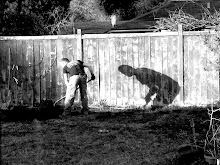
Since this is, after all, my blog, I could easily make up an inspiring and entertaining yarn here about how I told the clients to shove it, that no amount of money, even in a torpid economy, would be worth the shame to all involved of subverting the citrusy delight of witchhazel with the ammoniacal stench of some foul mulch, and furthermore shame on you for suggesting such a thing, and even furthermore, you don't deserve this horticultural treasure so sit there and watch me as I gently dig it up and tote its fragrant bulk off to sanctuary (black and white shot of me at dusk, gigantic witchhazel perched Atlas-like between my shoulder blades, as I trot down Queen Anne Avenue into the silhouetted skyline of Seattle, townsfolk leaning out of windows showering me with confetti and rose petals, desperately holding out babies for me to bless, give my name to and possibly sire siblings for).
But not so long ago, I promised to never abuse the fantastic power I assume with the title of Blogger. So if you must know, I spent two days toting buckets of mulch from an old pickup truck and unceremoniously tossing it will-he nill-he beneath every plant in sight (black and white shot of same), including 'Jelena' and the lovely hedge of Sarcococca confusa just coming into bloom. How do I sleep with myself having so compromised my gardening integrity? I go home, inhale deeply of the Sarcococca hedge outside my own walls, bury my face in 'Arnold Promise' and remind myself that someday, when I am King of all Gardens and rule with an Ironwood fist, I will see my clients against the wall for the crimes they have made me commit.
(This may be a bad time, but in the next election, be sure to vote for me as King of all Gardens; I will be running on the Ironwood Fist ticket.)

Wednesday, January 7, 2009

Wind Through The Trees

Our gardening heritage stems from an ancient kernel of admiration, respect, fear and deification of nature. How easy it is to forget this when browsing the orgiastic horticultural library that is the modern nursery for a new acquisition to round out a bed (oh, something evergreen, with scented flowers, grows fast but doesn't get too big...). A springtime nursery, with customers lasciviously stalking endless tables overflowing with petals, stamens and carpels; sleeves and noses dusted with incriminating pollen, resembles wild nature like pornography resembles courtship: it's all about reproduction, but somewhere along the way bits of subtlety and context have been lost.
So how does one regain the awe and respect of plants that led ancients to see in them symbols of their own gods? A couple suggestions: if you want to feel the calm beauty of plants as they interact with and help compose nature, sit beneath a mature Douglas Fir tree and listen to the wind blow through its boughs; if you want to feel a slightly more terrifying beauty and seriously question your chosen vocation, spend a whole day gardening beneath a forest of mature Douglas Fir trees and listen to gale force winds howl through their boughs, snapping off limbs like dry twigs for kindling. Try to concentrate on weeding as the sickening groans and cracks punctuate the air above you like some primeval air raid. Now place said trees on the side of a steep, supersaturated, landslide-prone bank and continue blithely raking up leaves as nature and the botanical world become vengeful gods around you. Hopefully, with the help of a little adrenaline, you might see: this is not about the right plant for your little yard; this is not about finding a Hosta with the same blue tones as your shutters; this is certainly not about countless potted plants served buffet style with helpful little name tags. The carefully arranged green things in your garden owe their existance to ancestors who survived to reproduce in a dangerous world.
It is not my intention to spoil your next trip to the nursery, but I must warn that if you do take my advice and cultivate this new perspective within you, you will not soon look at those rows of friendly, pretty plant genitals the same way.